Councils can put solar on schools, leisure centres, depots, offices, car parks and council land to cut their own energy bills and meet climate commitments. Since the Public Sector Decarbonisation Scheme ended for new projects, Great British Energy's £1 billion Local Power Plan has become the main source of new support.
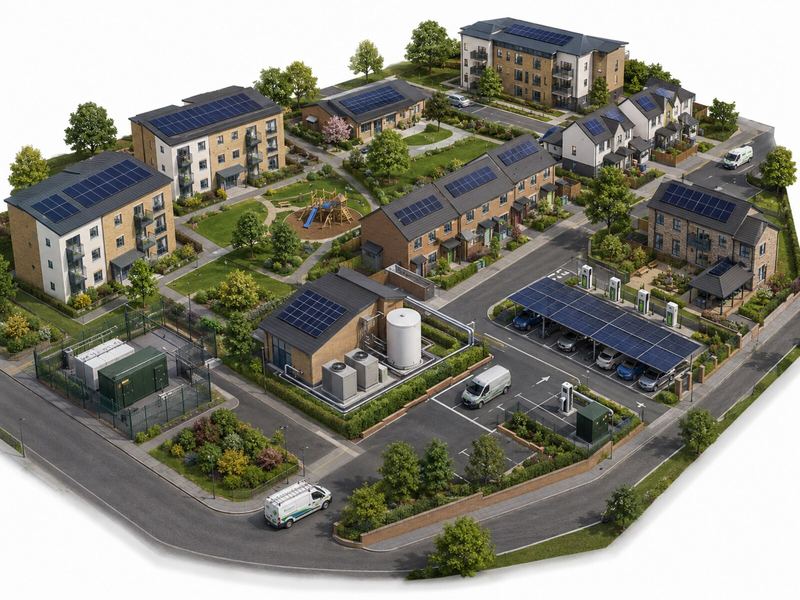
Where solar fits on a council estate
- Leisure centres and pools, which use a lot of electricity all day, every day.
- Depots and offices, with large roofs and working-hours demand.
- Schools, where generation lines up with the school day.
- Car parks, where canopies add shelter and EV charging, and can be permitted development in England with prior approval.
- Council land, such as closed landfill or land next to council buildings, for ground-mounted arrays.
Think in portfolios, not single buildings
A council estate is many sites with different roofs, demand and lease arrangements. Grouping them into one programme brings down the cost per kWp, makes the package more attractive to funders, and lets strong sites support weaker ones. Start by ranking buildings on roof condition, demand and how long the council expects to keep them. The calculator can model several buildings at once, by map or by dimensions.
Funding council solar
- Great British Energy Local Power Plan. Up to £1 billion for local and community energy over the Spending Review period, including solar and batteries on public buildings, partnership grants, loans and free advice.
- Mayoral Renewables Fund. £16 million across 14 Mayoral Strategic Authorities for renewables on public buildings.
- Public Sector Decarbonisation Scheme. Awarded projects continue, but no new funding beyond 2027/28.
- Prudential borrowing or a PPA. Councils can fund projects themselves or use a PPA so a funder pays for and maintains the system.
See our funding guide for how buying and PPAs compare.
Community energy and partnerships
The Local Power Plan aims for every community in the UK to have the chance to own a local energy project by 2030, and backs partnerships between councils and community energy groups, including shared ownership of larger projects. For larger cities, long-term partnerships with a private delivery partner can bring funding and delivery capacity for a whole programme, rather than procuring building by building.
Procurement
Council projects need a compliant procurement route. Frameworks shorten the process, but compare what each framework covers: design only, delivery, funding, or long-term operation. Agree early who will own, insure and maintain the systems, and how savings will be shared between the council and schools or tenants in council buildings.
Common questions
Is the Public Sector Decarbonisation Scheme still open?
No new rounds will be funded. The government decided in the June 2025 Spending Review not to fund the scheme beyond 2027/28, although projects already awarded are still being delivered.
What funding is there for council solar now?
Great British Energy's Local Power Plan is the main new source, with up to £1 billion for local and community energy, including solar on public buildings. Councils can also borrow or use a PPA.
Do solar car park canopies need planning permission?
In England, canopies over non-domestic car parks can be permitted development if they are no more than 4 metres high and at least 10 metres from homes, with prior approval before work starts.